
Navigating the Green Frontier: Can Cannabis Truly Ease Depression?
As traditional antidepressants don’t always provide relief for everyone, many patients are looking toward cannabinoids like THC and CBD as potential alternatives or adjunct therapies. However, the relationship between cannabis and depression is nuanced and often non-linear.
Drawing on clinical research from 2024 and 2025, here is an exploration of the potential benefits, the notable risks, and the critical safety considerations for those navigating this path.
The Potential Pros: Why Patients Seek Cannabis for Mood
At the center of this discussion is the Endocannabinoid System (ECS). Think of the ECS as your body’s "biological thermostat," maintaining homeostasis (internal balance) - a core principle of our holistic approach to mental health - across your mood, sleep, and stress response. Specifically, the ECS regulates the HPA axis—the system that manages how your brain and adrenal glands react to life’s stressors.
Clinical Symptom Relief: A landmark prospective study (Lunn et al., 2025) utilized real-time reporting to track adults new to medical cannabis. The results were noteworthy: participants reported significant decreases in depression and anxiety, with many seeing their scores drop below clinically significant levels within just three months. The most robust relief was associated with 10–15 mg of oral THC or vaporized cannabis.
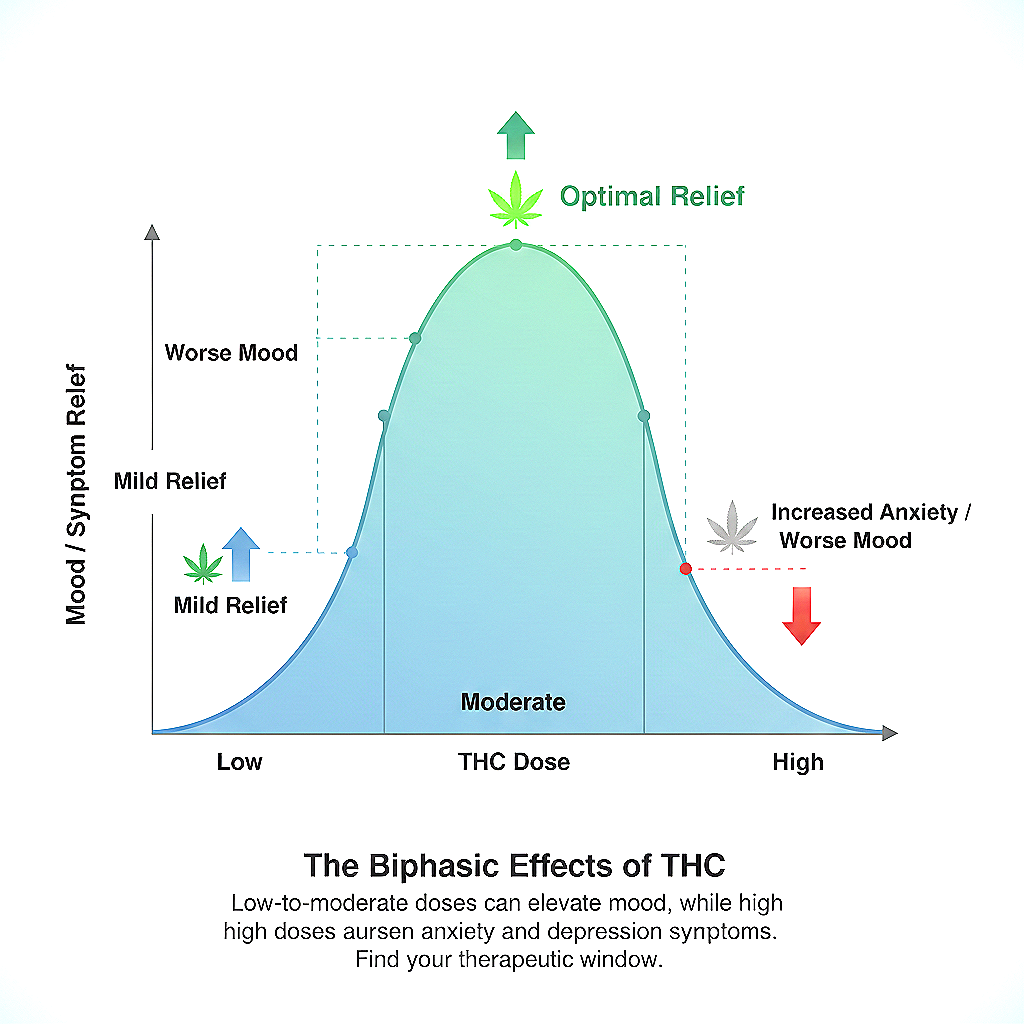
The "Bell Curve" Effect: Researchers have noted that THC often follows a biphasic or "bell curve" response. In low-to-moderate doses, it can stimulate serotonin receptors, acting as a mood elevator. At high doses it can actually reduce the desired effect.
Addressing Comorbidities: Depression rarely travels alone; it often brings "unwelcome friends" like insomnia and anxiety. Recent studies (Moreno-Sanz et al., 2025) suggest that by improving sleep architecture and reducing physiological stress markers, cannabinoids can indirectly lift the overall "burden" of depression.
The Entourage Effect: Modern research highlights that the combination of various terpenes (like linalool or myrcene) and cannabinoids may work synergistically. This "Entourage Effect" allows for a more tailored approach than a standard pharmaceutical pill, potentially offering "uplifting" or "calming" effects based on the specific strain profile.
The Cons: The Risks of the "Green Cure"
While the short-term effects may feel like a rescue, recent longitudinal data suggests that "more" is not always "better."
The "Rebound" Effect: Heavy or long-term use of high-THC cannabis has been linked to a worsening of depressive symptoms over time. What feels like relief in the moment can lead to a "come down" that deepens the depressive state.
Long-Term Longitudinal Risks: A 2025 meta-analysis in Psychological Medicine reviewed 22 studies and found that frequent cannabis users have a 29% higher risk of developing chronic depression compared to non-users. This suggests that while cannabis might help a depressed person feel better today, it might also make a healthy person more vulnerable to depression tomorrow.
Amotivational Syndrome: There is significant concern regarding the "flatness" associated with heavy use. This state of lethargy and lack of social or occupational drive can mirror the symptoms of depression, making it difficult for patients and doctors to determine if the depression is improving or if the cannabis is masking a lack of progress.
Medication Interactions: A Critical Concern
If you are currently taking prescription antidepressants, adding cannabis to the mix is not a neutral act. The liver uses the same metabolic pathway—the Cytochrome P450 system—to process both cannabinoids and many common medications.
SSRIs/SNRIs: CBD inhibits the liver's ability to clear these drugs. Increased risk of Serotonin Syndrome, tremors, and "brain fog."
Tricyclic Antidepressants (TCAs): THC adds significant cardiovascular stress. Risk of rapid heart rate and hypertension.
Sedatives (e.g., Xanax, Ambien): Cannabis amplifies the central nervous system depression. Excessive drowsiness, impaired coordination, and respiratory depression.
The Bottom Line: Consult Your "Clinical Compass"
Medical cannabis is a potent pharmacological tool, not a harmless herb. Because it can interact with your existing medications and potentially alter your brain’s serotonin baseline, it is essential to consult with your healthcare provider prior to use.
At ElevateCareNP, our providers help you help you find a balanced ratio of CBD to THC that minimizes risks while maximizing potential relief.
Sources:
Churchill RK, et al. The association between cannabis and depression: An updated Systematic Review and Meta-analysis. Psychological Medicine. 2025. Link
Cuttler C, et al. A naturalistic examination of the perceived effects of cannabis on negative affect. Journal of Affective Disorders. 2018. Link
Lowe HI, et al. The Therapeutic Potential of Cannabis and its Constituents in Secondary Symptoms of Depression. Molecules. 2021. Link
Lunn S, et al. Acute and chronic effects of medicinal cannabis use on anxiety and depression. Journal of Affective Disorders. 2025. Link
Moreno-Sanz G, et al. Cannabis-based medical products for insomnia: A long-term observational study. PLOS Mental Health. 2025. Link
O’Neil ME, et al. Benefits and Harms of Plant-Based Cannabis for PTSD: A Systematic Review. Annals of Internal Medicine. 2017. Link
The information in this post is intended for educational purposes only. This information neither substitutes for nor replaces professional legal or medical advice, diagnosis, or treatment. No content on this site should ever be regarded as a substitute for direct medical advice from your doctor or other qualified clinician.
